1. Who is Buddha Kanakamuni?
1.1. General introduction to Buddha Kanakamuni
In the Buddhist canonical system, Buddha Kanakamuni is considered one of the past Buddhas with a special role. He is identified as the second Buddha among the five Buddhas of the Kalpa and the fifth among the seven past Buddhas, appearing before Shakyamuni Buddha. According to the explanation of the Vietnam Buddhist Sangha, the title "Kanakamuni" symbolizes His pure virtue and radiant wisdom in the early Buddhist tradition.
The title Kanakamuni carries a profound meaning, often translated as "Golden Sage" (Bậc Tiên Vàng) or "One Who Has Been Fully Accomplished" (Koṇāgamana). Legend has it that on the day of His birth, a rain of gold fell across the Jambudvipa continent, heralding the appearance of a supremely wise being.
1.2. Origin and background of Buddha Kanakamuni
Buddha Kanakamuni was born into a Brahmin (high-ranking) family of the Kassapa clan. His father was the wealthy and learned Brahmin Yajñadatta. His mother was the virtuous Uttarā. The birthplace of Buddha Kanakamuni was the city of Sobhavatī - a prosperous center at that time, now believed to be near Araurakot, Nepal.

In the Buddhist canonical system, Buddha Kakusandha (Kanākāmuni) is considered one of the past Buddhas with a special role.
According to scriptures, during the time when Buddha Kakusandha appeared, human lifespan was 30,000 years. Scriptures describe Him as a person of serene disposition, taciturn, with a compassionate heart, intelligent from childhood, always inclined to observe the inner self and the surrounding life. From a young age, He showed a tendency towards goodness, understood the impermanent nature of life, and gradually abandoned worldly life to pursue enlightenment.
He lived in three magnificent palaces and ruled the kingdom for three thousand years with full power and wealth. Despite enjoying a royal life with his wife and son, Bodhisattva Kakusandha always carried a heavy heart about the impermanence and suffering of sentient beings.
2. The process of cultivation and the place of enlightenment under the fig tree
2.1. The cultivation process of Buddha Kakusandha
Just like Buddha Shakyamuni later, Bodhisattva Kakusandha witnessed the Four Signs (Birth, Old Age, Sickness, Death) and realized the vanity of the world. He decided to renounce the throne, palaces, and family to seek the Right Path, liberating himself from the cycle of rebirth. This was an extraordinary act, opening up a path of diligent cultivation for Him.
After renouncing worldly life, Buddha Kakusandha underwent a period of strict and ascetic cultivation to purify body and mind. He practiced the teachings passed down by past Buddhas, seeking the Middle Way, avoiding the extremes of self-mortification and sensual indulgence. However, like other Buddhas, He was not satisfied with teachings that led only to partial liberation.
After a period of studying the Dharma, He retreated into the deep forest to practice meditation. After 6 months of dedicated asceticism, He attained Samyak Sambuddha (Perfect Enlightenment) under the Udumbara tree (fig tree) – a tree considered sacred, whose flowers rarely bloom and each blooming is seen as an auspicious sign heralding the appearance of a Saint or a Wheel-Turning Monarch.
2.2. The significance of enlightenment under the fig tree
This is a sacred tree that appears many times in scriptures as a symbol of ripened wisdom, similar to the Bodhi tree of Buddha Shakyamuni later. This event is described as "golden light spreading," coinciding with the meaning of His name - Kanakamuni: "Pure golden light." Buddha Kakusandha attained Buddhahood under the fig tree in a region described as peaceful, with lakes, vegetation, and birds. This location is tentatively identified by researchers as belonging to the North Indian region, near the ancient Himalayas.

After renouncing the world, Krakucchanda Buddha underwent a period of strict and ascetic practice to purify body and mind.
According to Buddhist dictionaries, Udumbara, scientifically named Ficus glomerata and belonging to the Mulberry family, is the tree we commonly call the fig tree today. Biologically, the Udumbara tree typically grows 3 to 10 meters tall and is mainly distributed in the Himalayas, the Deccan Plateau, Sri Lanka, and many regions of South Asia. The leaves are about 10-15cm long and come in two forms: smooth and slightly rough. A notable characteristic of this species is that it belongs to the group of plants with hidden flowers, meaning the flowers are not exposed externally but are contained entirely within the structure of the fruit. Therefore, a "fig fruit" is actually a closed inflorescence, containing countless tiny flowers that bloom silently inside.
It is precisely because of this special characteristic that Udumbara holds a profound meaning in Buddhism. Some scriptures describe it as a sacred tree that rarely "blooms," and each appearance is considered an auspicious sign, heralding the birth of a Buddha or a Chakravartin (Wheel-Turning Monarch). Thus, the image of Krakucchanda Buddha is often associated with the fig tree – a symbol of wisdom shining in tranquility and gentleness.
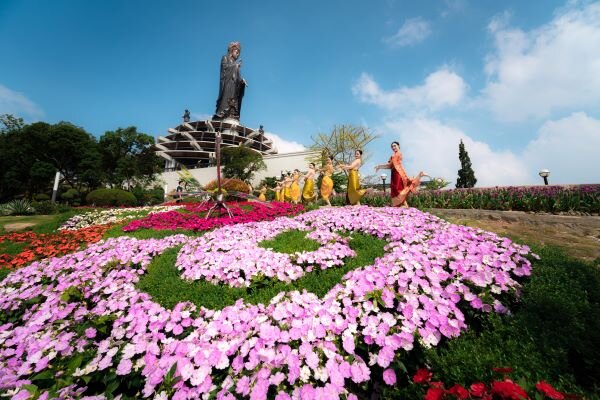
In Vietnamese folk culture, the fig tree is associated with the concepts of prosperity, fulfillment, and good fortune. Therefore, placing a statue of Krakucchanda Buddha alongside the image of a fig tree not only reflects the standard spirit in Buddhist aesthetics but also conveys wishes for peace and prosperity to all who come to pay homage.
In Buddhist tradition, Udumbara is also considered a rare tree, often linked to extraordinary events. Scriptures state that when a fully enlightened being appears, the tree blossoms, symbolizing the blossoming of truth amidst the world. For Buddhist practitioners, this image reminds us that wisdom does not come from mysterious things but from awakening to the true nature of all phenomena.
3. Philosophical Meaning from the Gatha of Krakucchanda Buddha
3.1. His First Sermon
During his time of teaching, **Krakucchanda Buddha** is recorded to have delivered his first sermon to a monastic assembly of up to 30,000 bhikkhus. In that very discourse, many attained the state of Arhatship, achieving complete liberation from the cycle of birth and death. This sermon not only initiated the propagation of his Dharma but also laid the foundation for the entire system of teachings that his disciples would later rely upon.
Among the teachings that have been passed down, his gatha is a concise instruction that fully embodies the spirit of practice of a fully enlightened being:
“Do not lightly regard precepts, diligently learn the path to Nirvana. The wise one is not sorrowful, resolutely eradicating all thoughts.”
The gatha of Krakucchanda Buddha is a steadfast reminder for practitioners: Maintain a pure mind, do not underestimate the smallest actions and thoughts; diligently learn the path, aiming for Nirvana, letting go of afflictions; live with wisdom, so as not to be swayed by worries and suffering; persistently eradicate all deluded thoughts, as they are the foundation for achieving liberation.
Thus, the entire gatha is a summary of the essence of Buddhism: cultivate precepts, nurture concentration, develop wisdom. Anyone who practices according to these verses, regardless of the era, can transform themselves, live peacefully, and move closer to the path of liberation from suffering.
3.2. Philosophical Meaning from the Gatha of Krakucchanda Buddha
This gatha, though brief, contains the three core elements of Buddhism: Precepts (Giới) - Concentration (Định) - Wisdom (Tuệ).
Do not lightly regard precepts
The opening line reminds that practitioners must always maintain a pure mind and be serious in their spiritual life. "Lightly regard" not only implies outward joking but also includes an attitude of disregarding principles, underestimating cause and effect, or letting the mind wander freely. The mind is the root of all good and bad karma; therefore, being careless with the mind is being careless with one's own path to liberation. The profound meaning is: be cautious in every thought, every internal reaction, as they are the source that shapes karmic retribution.

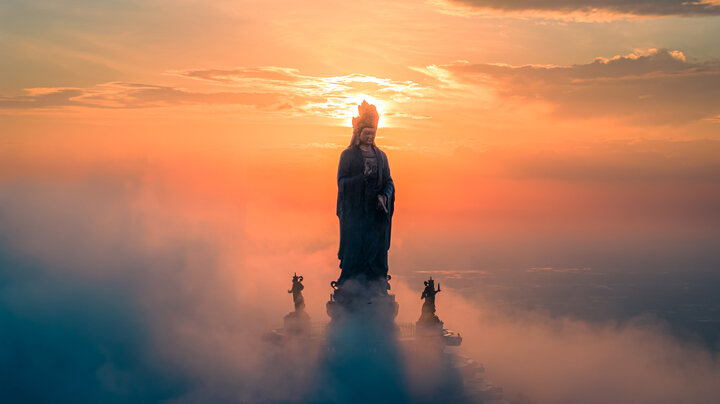
The peak of Ba Den Mountain is where the statue of Buddha Krakucchanda is located.
Need to learn the path of cessation
"Cessation" is the state when all afflictions subside, the mind is no longer agitated but becomes tranquil and clear. That is Nirvana. The verse reminds practitioners not only to learn the doctrine through intellectual understanding but, more importantly, to practice it themselves: meditate, maintain mindfulness, and observe every movement of the mind. The path cannot be achieved merely by speaking or reasoning, but must come from one's own cultivation experience. The message conveyed is: Return to nurture inner stillness, persevere in daily training to get closer to the state of cessation, and keep the mind steady amidst all life's fluctuations.
The wise do not grieve
A person becomes a "wise one" in Buddhism when they deeply understand cause and effect, impermanence, and live mindfully. Such a person no longer drowns in fear, regret, or sorrow. This verse affirms that when wisdom arises, sorrow naturally ceases, because fear originates from ignorance, while wisdom arises from the Dharma.
Determined to eradicate thoughts
"Thoughts" refer to unwholesome thoughts, greed-anger-delusion, wandering thoughts, and defilements that obscure the mind. The concluding verse expresses the determination to eradicate these afflictions at their root. Eradication here is not about forcing or resisting, but about clearly seeing their nature, and thereby letting go naturally. The content of this verse is the spirit of wisdom meditation: clearly seeing the mind, not clinging to wandering thoughts, and not creating further suffering.
The records about Buddha Krakucchanda offer Buddhist practitioners a complete perspective on a past Buddha with pure wisdom and vast vows. From his noble origin and upbringing to his journey of renouncing glory to seek truth, he left a shining example of steadfastness, diligence, and compassion. The event of enlightenment under the Bodhi tree further affirms the profound meaning of wisdom and favorable conditions in Buddhism. In particular, his precepts become a concise yet profound reminder, guiding practitioners to subdue their minds, live peacefully, not be negligent, and strive to eradicate all afflictions. Thus, his life and teachings continue to illuminate the path of practice for disciples today.